Posts

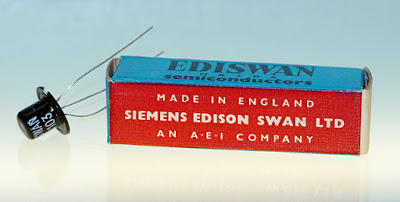
Ediswan Semiconductors
Image
Vintage Ediswan Mazda XB103 Germanium Transistor EDISWAN Germanium transistor originally from the late 1950s. The gain on this device is at the very top end of the gain spec @ 105. Edison and Swan merged in Britain in the late 1800s when Swan already held the dominant patents for the incadescent bulb. Ediswan were one of the original companies in the Associated Electrical Industries (AEI) merger from 1929 which included British Thomson Houston. Thomson Houston in the US became General Electric. Many British lamp companies moved into valves (tubes). Indeed the inventor of the first thermionic valve, Ambrose Fleming, worked at Edison Swan's factory at Ponders End in North London. Siemens Brothers (the other brothers) merged with Edison Swan in the early 1950s. It's not clear where Ediswan semiconductors were manufactured but may have been at Woolwich or Ponders End. Siemens Edison Swan had a research lab in West Road, Harlow in the late 1950s doing semiconductor res...

AEI Semiconductors

Image
AEI Semiconductors Avalanche Diodes British Thomson Houston established a semiconductor manufacturing facility in Carholme Road, Lincoln, England in 1956 with a focus on power devices. In 1963 it became part of AEI, and the AEI Rugby R&D team were transferred in 1966. In 1967 GEC acquired AEI, and in 1975 further semiconductor research activities in CMOS and RF were transferred from GEC Central Research to Lincoln. In the early 1980s a new facility was built in Doddington Road with ICs and RF devices transferred to the new facility. Carholme Road continued to produce power devices including general purpose and fast recovery diodes, GTOs and thyristors. Doddington Road produced standard, semi custom and full custom CMOS ICs and SOS devices for Space. RF devices included GaAs products, SAW filters and passives. Together with Hybrid facilities in Swindon and Portsmouth the company changed its name to Marconi Electronic Devices Ltd (MEDL). MEDL became uncompetitive in digital ...

Westinghouse Semiconductors

Image
2N609 : hfe=80, Vf=233mV. 2N60 : hfe=55, Vf=243mV Westinghouse created a US semiconductor group in the early 1950s to develop high power transistors. In 1956 they established a manufacturing facility in Youngwood PA and research groups in Wilkinson and Churchill Borough.    Westinghouse only produced low power transistors for a few years up until the early 1960s. The devices shown are the 2N60 from 1960 and 2N609 from 1963, and are gold finished. The Youngwood facility still exists as Powerex, a JV from 1986 between the power semiconductor divisions of Westinghouse and GE. Westinghouse Brake & Signal Company also had a UK facility which developed the first commercial rectifier in the 1920s. It became Westcode Semiconductors and is still in operation as IXYS.

Vintage British Diodes - Ferranti and STC

Image
Ferranti ZS72 200V silicon diodes and STC CV7476 600V Avalanche diodes   The Ferranti semiconductor division in Oldham, Greater Manchester was a prominent UK semiconductor supplier in the 1960s and 1970s, and produced the world's first programmable logic arrays. Ferranti eventually became Zetex Semiconductors, until acquired by Diodes Incorporated in 2008.       STC were the first manufacturer of point contact transistors in the UK, developed at STC in Ilminster, Somerset. STC moved valve (tube) manufacturing from Woolwich to the remote Ilminster in 1940. Volume semiconductor manufacturing was established in 1956 at the Brimar valve site in Footscray, Kent, eventually becoming part of Nortel before manufacturing ceased in 1993, when IC design was transferred to Nortel in Harlow.

Microprocessor History. Foundations in Glenrothes, Scotland

Image
Contemporary Calculator with 100 MSI ICs and 82 Transistors It is widely accepted that a small company in California called Intel developed the world's first microprocessor in 1971. In the late 60s and early 70s there was significant interest from calculator companies to further reduce the size and cost of desktop calculators, and to create a new market for personal calculators. Calculators had for some time used discrete transistors, and latterly discrete logic and custom MSI ICs, but a single chip calculator was only a vision. However, there was another microprocessor development happening in Glenrothes Scotland, also designed for the burgeoning calculator market which may have beat Intel to the market, both in timing and performance. The Formation of Pico Electronics Ltd Elliott Automation was a significant British computer maker who in the 1960s realised the need to progress its own semiconductor technology. In 1966 the company established a facility in Glenrothes to manufactu...

Burr-Brown PCM1702 A Really Interesting Audio DAC From the 90s

Image
Burr-Brown PCM1702-L I've just acquired from eBay a CD player to complement another very old CD player, both with Burr-Brown Digital to Analog converters. The photo shows the inside of the Denon CD-655 from the late 90s, a super low distortion and high signal to noise ratio CD player which uses 2 x PCM1702 DACs from Burr-Brown. The BiCMOS process 20-Bit PCM1702 was a really interesting DAC which was an improved version of the PCM63P. Early R-2R ladder DACs suffered from some noise/glitches at low output levels (and degraded linearity) due to the Most Significant Bit current source turning on at the lowest volume output point. Multi-bit DACs had significantly higher performance than contemporary 1-bit and "MASH" DACs, but had this one flaw. The PCM1702 was effectively two 19-bit DACs in a complementary design which negated the zero cross point issue. They had all the benefits of R-2R ladder DACs and now removed the other issue. Around this time Burr-Brown were al...

Japanese Transistor History

Image
Silicon npn transistors from Toshiba and Hitachi with an NEC pnp in the middle. Following the development of the point contact transistor at Bell Laboratories (and subsequent grown junction transistor development), Tokyo Tsushin Kogyu became the earliest Bell Labs transistor licensee in Japan. They moved quickly, producing their first transistor radio in August 1955. This was one year after Texas Instruments introduced the TR-1, the world's first production portable transistor radio. Tokyo Tsushin Kogyu, Hitachi, Tokyo Shibauro Electric, Mitsubishi Electric and Kote Kogyo became the first five Japanese transistor licensees of Bell Labs and Western Electric by July 1956. Tokyo Tsushin Kogyu became Sony and Tokyo Shibauro Electric became Toshiba. Semiconductor developments progressed quickly during the second half of the 1950s and by 1959 50% of transistor radios bought in the US were Japanese, or used Japanese transistors. Unlike in the US where the Defense market was s...

Clive Sinclair's First Products Were Transistors

Image
Sinclair, TI and Philco Transistors Clive Sinclair formed Sinclair Radionics in 1961, having a good understanding of electronics and transistor manufacturing. Always the entrepreneur, he bought a quantity of transistor test failures from Semiconductors Limited (Semics) of Swindon. As seems to be the norm in British semiconductor history, it was convoluted. Semics was actually Plessey who had licensed Micro Alloy Diffused Transistor technology from Philco in the US. Sinclair used the transistors in a very small pre-amplifier and sold both the amplifier and retested/re-badged transistors separately. Later on he must have done this again as ST140 and ST141 transistors were on the market, albeit probably in relatively small quantities again. Above left is an ST140 Sinclair transistor. There is also an original Philco MADT transistor on the right. In the middle is a UK manufactured Texas Instruments transistor. Texas Instruments opened a semiconductor plant in Bedford, UK in 1960 to ...

The Birth of the Home Video Game Mass Market

Image
Inside the Telstar. Calculator for Size Comparison The Coleco Telstar was launched in 1976. It played six games, but only three were offered in Coleco's first product. The General Instrument AY-3-8500 was the first single IC to offer multiple games, made available to every manufacturer, launching home video games as a mass market. It marked the end of discrete systems such as the Magnavox x00 products. The Coleco Telstar was a highly integrated system with only a few components for the GI chip. The RF cable/TV Out wrapped round the ferrite core in the photo above was a late addition/modification when Coleco failed its FCC approval. Ralph Baer, who had seen an early demo of the GI chip, and introduced the new General Instrument  IC to Coleco, suggested the addition to suppress EMI. Ed Saks, who was the head of GI had brought the two design guys from GI's Scottish facility to the US to develop the AY-3-8500 fully, and the further chips that came in the following years. ...

The First Silicon Transistors

Image
TI 904 Si transistor Texas Instruments introduced the 900 series silicon transistors in 1954, the first silicon transistors in history. The upstart TI of Dallas managed to beat the established East Coast companies to the first silicon products. It was through the hire of important Bell Labs people in the development of silicon that enabled the feat. The higher temperature operation of silicon was preferable over the dominant germanium, so getting Si products into the market would give that company an edge. TI started transistor development in Lemmon Avenue in Dallas and in 1958 moved to a 300 acre site at North Central Expressway. The Semiconductor building was the first building on the campus. The building is still there (although modified) and is now a Raytheon building following the acquisition of TI's defense business in 1997. I visited the facility during the 2000s and you could still see the roots of TI in the fabric of the building. hfe=28, Vf=725mV, low gain but it ...