Posts

Showing posts with the label bell labs

The First Commercially Available Transistor in Large Quantities

Image
This is a Raytheon Germanium Alloy Junction transistor from the very early 1950s. The CK718 was the first transistor manufactured in large quantities for commercial applications.  The socket is for a mini vacuum tube. Raytheon replaced tubes with transistors in hearing aids, one of the first applications for solid state transistors. Raytheon was quick off the mark in the early development of transistors and were first to market with the CK703 point contact transistor in 1948. The CK722 alloy junction transistor was the first widely available transistor and opened up the technology to hobbyists. CK722s were originally lower grade CK718 test rejects. In the background is part of the original Bell Labs internal voting form for the name of the new device they had invented. This is a high gain device, Hfe=176, Vf=189mV.
Point Contact Transistors

Image
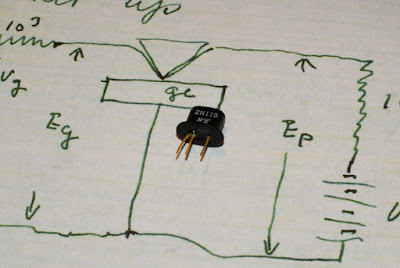
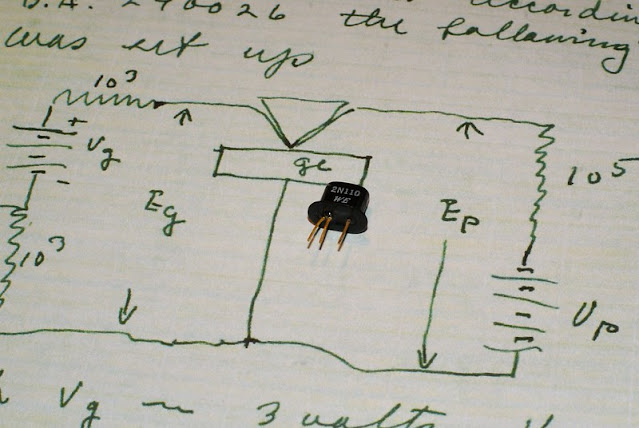
The first transistors developed by Bell Labs were Point Contact versions, created using an extension of diode manufacturing, which was a further refinement of diodes in 'cat's whisker' radios.  This 2N110 is a Western Electric Point Contact transistor from the 1950s. Point Contact transistors were difficult to manufacture and were superseded by grown junction, then alloy junction versions.  Western Electric continued to manufacture them longer than any other company since they were designed into telephone Central Office systems on a large scale. In the background is a page from Walter Brattain's logbook describing the first point contact transistor. A little bit more information in this previous post :  https://spingalhistory.blogspot.com/2017/02/bell-labs-point-contact-transistor.html  

Japanese Transistor History

Image
Silicon npn transistors from Toshiba and Hitachi with an NEC pnp in the middle. Following the development of the point contact transistor at Bell Laboratories (and subsequent grown junction transistor development), Tokyo Tsushin Kogyu became the earliest Bell Labs transistor licensee in Japan. They moved quickly, producing their first transistor radio in August 1955. This was one year after Texas Instruments introduced the TR-1, the world's first production portable transistor radio. Tokyo Tsushin Kogyu, Hitachi, Tokyo Shibauro Electric, Mitsubishi Electric and Kote Kogyo became the first five Japanese transistor licensees of Bell Labs and Western Electric by July 1956. Tokyo Tsushin Kogyu became Sony and Tokyo Shibauro Electric became Toshiba. Semiconductor developments progressed quickly during the second half of the 1950s and by 1959 50% of transistor radios bought in the US were Japanese, or used Japanese transistors. Unlike in the US where the Defense market was s...

The First Silicon Transistors

Image
TI 904 Si transistor Texas Instruments introduced the 900 series silicon transistors in 1954, the first silicon transistors in history. The upstart TI of Dallas managed to beat the established East Coast companies to the first silicon products. It was through the hire of important Bell Labs people in the development of silicon that enabled the feat. The higher temperature operation of silicon was preferable over the dominant germanium, so getting Si products into the market would give that company an edge. TI started transistor development in Lemmon Avenue in Dallas and in 1958 moved to a 300 acre site at North Central Expressway. The Semiconductor building was the first building on the campus. The building is still there (although modified) and is now a Raytheon building following the acquisition of TI's defense business in 1997. I visited the facility during the 2000s and you could still see the roots of TI in the fabric of the building. hfe=28, Vf=725mV, low gain but it ...

Bell Labs Point Contact Transistor

Image
Western Electric Point Contact Transistor Developed by John Bardeen and Walter Brattain at Bell Laboratories, the first transistor was a seminal moment in history. In the main because it was part of the American Telephone and Telegraph Company, Bell Labs was very open in its sharing of the invention, including its methods of manufacture. Being a monopoly, AT&T was very aware of anti-trust pressures. Bell Labs shared its knowledge with 40 licensees in 1951. From demonstrations in 1948, a number of companies had already seen the potential impact of the transistor and had started their own developments. Those with most to lose, the vacuum tube manufacturers, were quickest off the mark including Raytheon, the biggest supplier of mini vacuum tubes. Point Contact transistors were difficult to manufacture and their reliability was poor. Superior transistor manufacturing methods developed including grown junction and alloy junction. Western Electric at its Allentown PA facility contin...

Grown Junction Transistors

Image
Western Electric 2N27 Early Transistor To the left is a Western Electric grown junction transistor from the mid 1950s, when full rate production started on the first grown junction transistors. The technology was developed in Bell Labs after the point contact transistor, and was significantly more reliable and manufacturable. William Shockley, later to form Shockley Semiconductors on the West Coast, developed the theory of the grown junction transistor. However they didn't last too long, being pretty much superseded by Alloy Junction transistors. The 2N27, 2N28 and 2N29 were the first grown junction transistors. GE 2N167 Transistor General Electric were also an early developer or grown junction transistor technology. The 2N167 germanium grown junction transistor on the left is from the late 1950s. There is a small slab (or bar) of germanium which has been sliced from a larger grown crystal with impurities added to make the npn type transistor structure. The emitter and ...