Posts

Showing posts with the label glenrothes

AY-3-8500-1 Pong-on-a-Chip

Image
During the mid 1970s, there was a pong-on-a-chip development happening at General Instrument's facility in Glenrothes, Scotland. It was discovered by Ralph Baer, who got it designed into the Coleco Telstar, launched in 1976. It played six games, but only three were offered in Coleco's first product. The GI device was the first single IC to offer multiple games and was made available to every manufacturer, launching home video games as a mass market. It marked the end of discrete systems such as the Magnavox x00 products. The Coleco Telstar was a highly integrated system with only a few external discretes for the GI chip. In 1976 GI were selling the chip in volume for £6 (£40 today) into games that were £30 (£198 today) at the low end. By 1977 GI had a range of game ICs, including car racing, card games, submarine and other ball and paddle variants. It also offered the CP1600 microprocessor for programmable games consoles. The CP1600 eventually became the PIC micro, which has si...

Microprocessor History. Foundations in Glenrothes, Scotland

Image
Contemporary Calculator with 100 MSI ICs and 82 Transistors It is widely accepted that a small company in California called Intel developed the world's first microprocessor in 1971. In the late 60s and early 70s there was significant interest from calculator companies to further reduce the size and cost of desktop calculators, and to create a new market for personal calculators. Calculators had for some time used discrete transistors, and latterly discrete logic and custom MSI ICs, but a single chip calculator was only a vision. However, there was another microprocessor development happening in Glenrothes Scotland, also designed for the burgeoning calculator market which may have beat Intel to the market, both in timing and performance. The Formation of Pico Electronics Ltd Elliott Automation was a significant British computer maker who in the 1960s realised the need to progress its own semiconductor technology. In 1966 the company established a facility in Glenrothes to manufactu...

Computer Logic Cards

Image
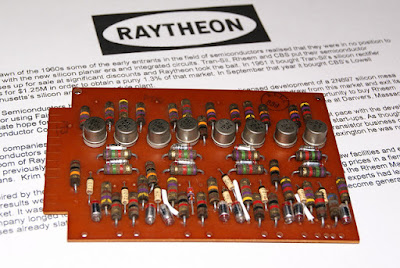
Germanium Alloy Junction Transistor Card From the Early 60s The 2N404 became the workhorse switching transistor of the computer industry, produced by a number of companies including RCA, GE, TI and Raytheon. Despite advances in silicon, mesa and planar structures, demand for germanium alloy junction transistors continued throughout the 1960s. This card also has eight Hughes Aircraft HG1012 germanium point contact diodes. HG signified Hughes Glenrothes, so these were UK manufactured. Interestingly the site that manufactured these diodes in the 1960s is now a working Raytheon facility.