Posts

Siemens & Halske Transistor Innovation

Image
The Siemens brothers were industrialists from the mid 19th century, Siemens & Halske being one arm of several. At some point post WWII, the remaining entities merged into Siemens AG.  The patent shown in the image was filed in Germany in 1956 and in the US one year later. At the time the dominant transistor manufacturing technology was alloy junction. The method described in the patent was an early adoption of diffusion for creating the process layers with masking and etching, similar to the mesa transistor structure which emerged around the same time in the US. Depositing metal instead of attaching gold wires, embedding the diffused layers and a protective layer on the surface would be the basis of the planar process subsequently invented by Fairchild.  Siemens first established transistor manufacturing in their electron tube facility in Munich in 1952.

The First Telefunken Transistors

Image
Telefunken in Germany had been producing semiconductor rectifiers for a number of years before they developed transistors for mass production. Launched in 1953, the OC601 and OC602 were alloy junction germanium pnp transistors. Telefunken also developed S (special) versions which had attached copper heatsinks. These work but are low gain.  hfe=26, Vf=97mV. hfe=18, Vf=100mV.

Philco Ge Transistor 2N1500

Image
Small changes having a big impact. Introduced in 1960, Philco had by then improved their etching process to create the thin base layer of their germanium alloy junction transistors. They then replaced the indium electrodes making the emitter and collector junctions with cadmium, giving better thermal dissipation. Due to its speed and thermal performance, it became widely used in computers of the time. These were manufactured by Philco (later Philco-Ford) at their factory in Spring City, PA. One AI processor chip now has more transistors than the first 25 years at least of the semiconductor industry!  It works, hfe (gain) is 96, Vf=273mV (so germanium).

The Bucket Brigade

Image
Inside the Boss HA-5 headphone guitar amplifier from 1983. It had built in chorus and delay effects. The chorus came from the Boss CE-3 guitar pedal and used the Matsushita/Panasonic MN3207 Bucket Brigade Device and the accompanying MN3102 clock generator chip. The NEC IC on the left is an analog compander device i.e. it compresses and expands a signal. The Bucket Brigade concept, developed by Philips Research Labs, had a series of on-chip capacitors between which charges moved in sequence, based on an external clock cycle. It was also a precursor to the Charge Coupled Device (CCD) that was developed as the first significant semiconductor image sensor.

Raytheon Quad OpAmp

Image
Raytheon sold its semiconductor operations in Mountain View CA to Fairchild in 1997. Fairchild was then a re-incarnation, not the original Silicon Valley pioneer. Raytheon had originally purchased Mountain View's Rheem in 1959, two years after it had spun out from Fairchild, led by Ed Baldwin who had moved from Hughes Semiconductors to Fairchild. Raytheon was expanding its transistor manufacturing into California through the acquisition. Like many companies, Raytheon expanded into bipolar and MOS circuits. Cyrus Madavi, who led Burr-Brown through to acquisition by TI came from Raytheon. I worked for Hughes, Raytheon and Burr-Brown.

ASM Germanium Diode

Image
In 1962 Mullard (Philips) and GEC pooled their resources and facilities to create Associated Semiconductor Manufacturers. Mullard owned 2/3 of the combined business. GEC pulled out in 1969. This is a small signal diode CV7364/AAZ12, germanium, Vf=258mV.

Alloy Junction Transistors From RCA

Image
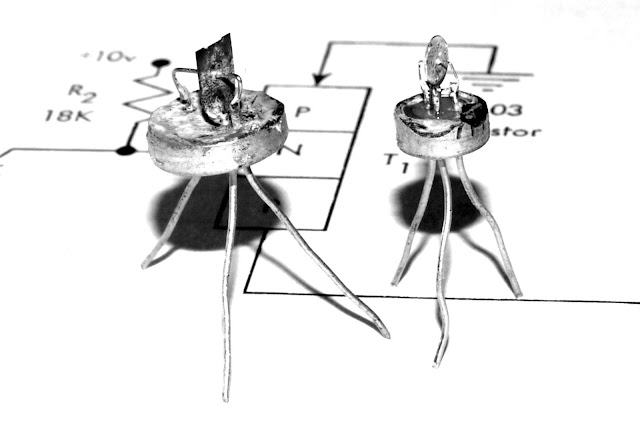
Inside two RCA alloy junction transistors from the 1950s. The smaller one is a 40V/50mA pnp and the larger is a 40V/250mA, hence the thicker wires for lower loss at the higher current. The metal connecting the base is also larger to provide better heat dissipation. The base is a thin cut slice of pure n-type germanium which has indium pellets alloyed to each side creating the pnp junctions.  There was viscous white goo inside the cases which was difficult to remove.

Texas Instruments Germanium Grown Junction Transistor

Image
TI introduced the 900 series silicon transistors in 1954 but they continued to produce germanium transistors. The germanium grown junction 2N172 was introduced in 1956, adding to their transistor portfolio for radios. TI and IDEA introduced the first all transistor radio (Regency TR-1) in 1954. TI started transistor development in Lemmon Avenue in Dallas and in 1958 moved to a 300 acre site at North Central Expressway. The Semiconductor building was the first building on the campus. The building is still there (although modified) and is now a Raytheon building following the acquisition of TI's defense business in 1997.  Working transistor, hfe=23, Vf=183mV, fairly low gain.

Sylvania Germanium Transistors

Image
Germanium transistors from 1955. In the early 1950s Sylvania established transistor and diode manufacturing at their tube (valve) facility in Emporium PA. Manufacturing was transferred to the Electronics Divsions in Woburn Mass. In 1957 it was divided into two new organizations, the Semiconductor Division and Special Tube Operations. Skyworks, one of the current world leaders in RF components for smartphones has its roots in Sylvania, Woburn.

RCA Germanium Transistors for Audio

Image
The 2N109 was the first widely used 'hobbyist' RCA transistor and was used in AM receiver and preamplifier circuits. RCA originally established transistor development and manufacturing at Harrison NJ, then built a dedicated solid state operation at Somerville NJ in 1955.

SACD Passed me by, Until Now (Updated 2026)

Image
Back in the day I knew about DSD (Direct Stream Digital) and SACD (Super Audio CD) but it passed me by. I was still in Burr-Brown when DSD data converter ICs were first being developed by the design team in Japan, and I'm sure I was present when they were being presented at seminars to customers, but at the time I had little or no interest in diving in personally. Burr-Brown invested heavily in designing ICs for the upcoming market demand, but as history tells us, it didn't become mainstream. Certainly not in the US, less so in Europe, but in Japan there was always demand. Philips and Sony originally developed SACD as the high end next generation of CD, and certainly the format was capable of encoding a significantly higher level of audio information on the platform. DSD was a delta-sigma bitstream format that sampled 1-bit at 2.8MHz. Philips Semiconductors (amongst others) developed an SACD processor and Burr-Brown (amongst others) developed DSD Digital to Analog converters. L...

Burr-Brown 12-Bit Digital to Analog Converters From the 1980s

Image
The photo above shows a hybrid technology 12-bit D/A Converter from Burr-Brown Corporation. By 1986 this was replaced by a monolithic i.e. single chip design. Under the metal lid is a ceramic substrate based multi-chip module. See below for examples of the technology. DAC85 is the model number. The 1st C is the operating temp range (0 to 70C). CBI is complementary bipolar inputs and V is the voltage output version. 12-bit DACs from Burr-Brown were used primarily in industrial applications like automation and factory control. If you only know DACs for digital audio, then 12 bit may seem a low resolution, but parameters that were most important for high end industrial use would not be relevant for audio. These DACs were very precise.

Burr-Brown Operational Amplifiers

Image
Burr-Brown Research Corporation introduced the first solid state modular op amp in 1962. It was a circuit board based device with discrete transistors, resistors, capacitors etc in a fully tested potted module. The 1510 example potted module op amp in the image is date coded 1971.  Fairchild Semiconductor had introduced monolithic bipolar op amps in the 1960s but they were low performance.  There was no ability to trim parameters on-chip, but within the Burr-Brown modules it was possible.  It wasn't until the likes of Burr-Brown and Precision Monolithics developed on-chip thin film laser trimming that precision analog ICs were introduced. The Burr-Brown OPA134 OpAmp on top for size comparison is from 1996.

The First Commercially Available Transistor in Large Quantities

Image
This is a Raytheon Germanium Alloy Junction transistor from the very early 1950s. The CK718 was the first transistor manufactured in large quantities for commercial applications.  The socket is for a mini vacuum tube. Raytheon replaced tubes with transistors in hearing aids, one of the first applications for solid state transistors. Raytheon was quick off the mark in the early development of transistors and were first to market with the CK703 point contact transistor in 1948. The CK722 alloy junction transistor was the first widely available transistor and opened up the technology to hobbyists. CK722s were originally lower grade CK718 test rejects. In the background is part of the original Bell Labs internal voting form for the name of the new device they had invented. This is a high gain device, Hfe=176, Vf=189mV.

Point Contact Transistors

Image
The first transistors developed by Bell Labs were Point Contact versions, created using an extension of diode manufacturing, which was a further refinement of diodes in 'cat's whisker' radios.  This 2N110 is a Western Electric Point Contact transistor from the 1950s. Point Contact transistors were difficult to manufacture and were superseded by grown junction, then alloy junction versions.  Western Electric continued to manufacture them longer than any other company since they were designed into telephone Central Office systems on a large scale. In the background is a page from Walter Brattain's logbook describing the first point contact transistor. A little bit more information in this previous post :  https://spingalhistory.blogspot.com/2017/02/bell-labs-point-contact-transistor.html  

Transitron Electronic Corporation

Image
2N543 Silicon NPN Transistors From 1965 / Zener Diode From the Late 1950s Founded in 1952 by the Bakalar brothers, David and Leo, Transitron became the world's largest and most highly valued semiconductor company in the late 1950s. Although it took a planar process license from Fairchild in the early 1960s it never regained its pre-eminent position. Transitron started in Melrose Mass and grew very quickly, moving to an old mill in Wakefield. At its peak it employed more than 10,000 people.  2N343 Silicon Grown Junction Transistors From 1961 In its early years the Bakalars were very active in recruiting top engineers from Europe. They would hold recruitment roadshows in major capital cities. A number of these recruits subsequently became pioneers in other semiconductor companies. Not just from Transitron, but much of the top talent migrated West to seek their fortunes. The established East Coast companies didn't adapt and provide stock options or other incentives. Transistron 2N...

Lucas Industries' Semiconductor Products

Image
Lucas Industries were a major 20th century British electrical manufacturer, supplying Automotive and Aerospace sectors. At one point they had 93,000 employees and 27 sites in the UK. Semiconductor manufacturing likely started in the early 1960s at the Mere Green Road site in Sutton Coldfield. Many Lucas sites were based in the Birmingham and West Midlands area. The Mere Green Road site didn't produce any Germanium products, they started with Silicon. They produced a range of low power transistors and diodes, then moved into power transistors. On the same site they manufactured Hybrid package products for both Automotive and Aerospace. The above photo is from the mid 1980s and shows semiconductor workers. The DT1602 devices are npn transistors with low gains (hfe= 7 & 20).

AY-3-8500-1 Pong-on-a-Chip

Image
During the mid 1970s, there was a pong-on-a-chip development happening at General Instrument's facility in Glenrothes, Scotland. It was discovered by Ralph Baer, who got it designed into the Coleco Telstar, launched in 1976. It played six games, but only three were offered in Coleco's first product. The GI device was the first single IC to offer multiple games and was made available to every manufacturer, launching home video games as a mass market. It marked the end of discrete systems such as the Magnavox x00 products. The Coleco Telstar was a highly integrated system with only a few external discretes for the GI chip. In 1976 GI were selling the chip in volume for £6 (£40 today) into games that were £30 (£198 today) at the low end. By 1977 GI had a range of game ICs, including car racing, card games, submarine and other ball and paddle variants. It also offered the CP1600 microprocessor for programmable games consoles. The CP1600 eventually became the PIC micro, which has si...

IBM Monolithic Systems Technology

Image
The IBM System/360 mainframe development which started in 1961 was the biggest product development in corporate history. Costing $5B at the time ($44B today), it was a huge gamble, but it paid off handsomely for IBM. They dominated the market for the remainder of the mainframe computer era. There were several big innovations which created its success, including, upwards/downwards software compatibility across the range, standard interface for many different peripherals, emulation of other platform developed software, adoption of the 8-bit byte and Solid Logic Technology. Seen in close up, SLT was a ceramic substrate technology with printed resistors and mounted transistors, creating Resistor Transistor Logic (RTL) blocks. The resistors were trimmed before the lid was put on the modules. IBM gambled in large part because they were facing increasing stiff competition. One of their competitors launched a product with early logic integrated circuits. IBM had considered this but felt the te...

Vintage Germanium Thorn-AEI (Family) Transistors

Image
The early history of British Semiconductor manufacturing is pretty convoluted. There are many different brands which ended up being manufactured by the same company, and some major brands which remained from long gone acquisitions. Mazda was a brand in Britain from 1911, initially for light bulbs, eventually transferring to the Thorn company. Thorn also acquired the Brimar brand when STC's Valve (Tube) and CRT business was acquired in 1960. Thorn Electrical Industries then created a JV in 1961 with AEI, itself a combination of British Electrical manufacturers. The plan was to pool its combined activities in Valves, CRTs and Semiconductors. Manufacturing was in Brimsdown (adjacent to Ponders End - the site of the Edison Swan Company). EDISWAN transistors were also part of the group, and its transistors were manufactured in Ponders End. The original Cosmos Lampworks factory built in Brimsdown was adjacent to the equivalent Edison Swan factory. Through acquisition and grow...