Posts

The First Commercially Available Transistor in Large Quantities

Image
This is a Raytheon Germanium Alloy Junction transistor from the very early 1950s. The CK718 was the first transistor manufactured in large quantities for commercial applications.  The socket is for a mini vacuum tube. Raytheon replaced tubes with transistors in hearing aids, one of the first applications for solid state transistors. Raytheon was quick off the mark in the early development of transistors and were first to market with the CK703 point contact transistor in 1948. The CK722 alloy junction transistor was the first widely available transistor and opened up the technology to hobbyists. CK722s were originally lower grade CK718 test rejects. In the background is part of the original Bell Labs internal voting form for the name of the new device they had invented. This is a high gain device, Hfe=176, Vf=189mV.
Point Contact Transistors

Image
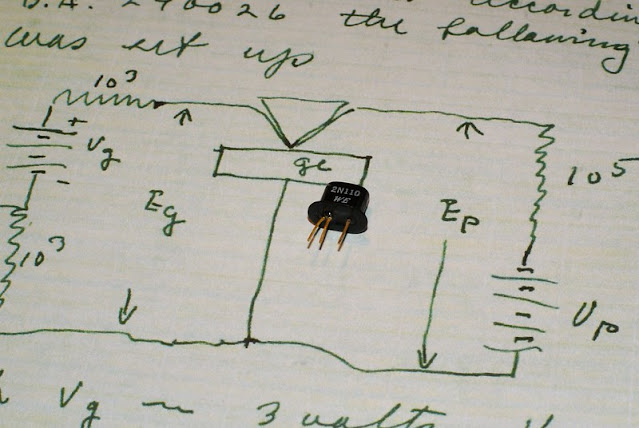
The first transistors developed by Bell Labs were Point Contact versions, created using an extension of diode manufacturing, which was a further refinement of semiconductor rectifiers in 'cat's whisker' radios.  This 2N110 is a Western Electric Point Contact transistor from the 1950s. Point Contact transistors were difficult to manufacture and were superseded by grown junction, then alloy junction versions.  Western Electric continued to manufacture them longer than any other company since they were designed into telephone Central Office systems on a large scale. In the background is a page from Walter Brattain's logbook describing the first point contact transistor. A little bit more information in this previous post :  https://spingalhistory.blogspot.com/2017/02/bell-labs-point-contact-transistor.html  

Transitron Electronic Corporation

Image
2N543 Silicon NPN Transistors From 1965 / Zener Diode From the Late 1950s Founded in 1952 by the Bakalar brothers, David and Leo, Transitron became the world's largest and most highly valued semiconductor company in the late 1950s. Although it took a planar process license from Fairchild in the early 1960s it never regained its pre-eminent position. Transitron started in Melrose Mass and grew very quickly, moving to an old mill in Wakefield. At its peak it employed more than 10,000 people.  2N343 Silicon Grown Junction Transistors From 1961 In its early years the Bakalars were very active in recruiting top engineers from Europe. They would hold recruitment roadshows in major capital cities. A number of these recruits subsequently became pioneers in other semiconductor companies. Not just from Transitron, but much of the top talent migrated West to seek their fortunes. The established East Coast companies didn't adapt and provide stock options or other incentives. Transistron 2N...

Lucas Industries' Semiconductor Products

Image
Lucas Industries were a major 20th century British electrical manufacturer, supplying Automotive and Aerospace sectors. At one point they had 93,000 employees and 27 sites in the UK. Semiconductor manufacturing likely started in the early 1960s at the Mere Green Road site in Sutton Coldfield. Many Lucas sites were based in the Birmingham and West Midlands area. The Mere Green Road site didn't produce any Germanium products, they started with Silicon. They produced a range of low power transistors and diodes, then moved into power transistors. On the same site they manufactured Hybrid package products for both Automotive and Aerospace. The above photo is from the mid 1980s and shows semiconductor workers. The DT1602 devices are npn transistors with low gains (hfe= 7 & 20).

AY-3-8500-1 Pong-on-a-Chip

Image
During the mid 1970s, there was a pong-on-a-chip development happening at General Instrument's facility in Glenrothes, Scotland. It was discovered by Ralph Baer, who got it designed into the Coleco Telstar, launched in 1976. It played six games, but only three were offered in Coleco's first product. The GI device was the first single IC to offer multiple games and was made available to every manufacturer, launching home video games as a mass market. It marked the end of discrete systems such as the Magnavox x00 products. The Coleco Telstar was a highly integrated system with only a few external discretes for the GI chip. In 1976 GI were selling the chip in volume for £6 (£40 today) into games that were £30 (£198 today) at the low end. By 1977 GI had a range of game ICs, including car racing, card games, submarine and other ball and paddle variants. It also offered the CP1600 microprocessor for programmable games consoles. The CP1600 eventually became the PIC micro, which has si...

IBM Monolithic Systems Technology

Image
The IBM System/360 mainframe development which started in 1961 was the biggest product development in corporate history. Costing $5B at the time ($44B today), it was a huge gamble, but it paid off handsomely for IBM. They dominated the market for the remainder of the mainframe computer era. There were several big innovations which created its success, including, upwards/downwards software compatibility across the range, standard interface for many different peripherals, emulation of other platform developed software, adoption of the 8-bit byte and Solid Logic Technology. Seen in close up, SLT was a ceramic substrate technology with printed resistors and mounted transistors, creating Resistor Transistor Logic (RTL) blocks. The resistors were trimmed before the lid was put on the modules. IBM gambled in large part because they were facing increasing stiff competition. One of their competitors launched a product with early logic integrated circuits. IBM had considered this but felt the te...

Vintage Germanium Thorn-AEI (Family) Transistors

Image
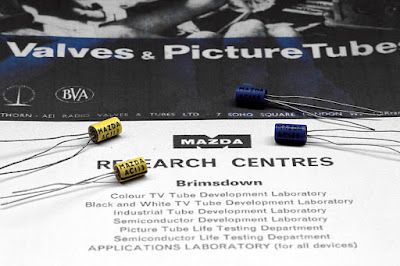
The early history of British Semiconductor manufacturing is pretty convoluted. There are many different brands which ended up being manufactured by the same company, and some major brands which remained from long gone acquisitions. Mazda was a brand in Britain from 1911, initially for light bulbs, eventually transferring to the Thorn company. Thorn also acquired the Brimar brand when STC's Valve (Tube) and CRT business was acquired in 1960. Thorn Electrical Industries then created a JV in 1961 with AEI, itself a combination of British Electrical manufacturers. The plan was to pool its combined activities in Valves, CRTs and Semiconductors. Manufacturing was in Brimsdown (adjacent to Ponders End - the site of the Edison Swan Company). EDISWAN transistors were also part of the group, and its transistors were manufactured in Ponders End. The original Cosmos Lampworks factory built in Brimsdown was adjacent to the equivalent Edison Swan factory. Through acquisition and grow...

The First Flash Drive

Image
In the photo is an M-Systems demonstration Disk-On-Chip from the 1990s, the forerunner of memory sticks and cards. The normally all black plastic package is top-filled with clear epoxy. The company was founded by Dov Moran and was based in Israel. The architecture remains the same for flash cards, SD etc. A high density standard memory chip and a separate controller chip (larger chip on the left above). IBM were the first company in the US to market flash drives, buying M-Systems' products and re-branding them. M-Systems were acquired by SanDisk.

Philips and Dolby HX-Pro

Image
Inside the Philips FC920 cassette deck from 1993. Recent purchase for a very small amount of money, to explore analog cassette tapes with better sounding equipment. This machine was equipped with Dolby HX-Pro which improved the overall sound of pre-recorded cassette tapes. It wasn't a noise reduction system like Dolby B or C, but was a dynamic signal bias system, implemented during the tape transfer process. Standard biasing mixed a high frequency fixed signal  to the source, to make the signal more linear (and better sounding).    HX-Pro (invented by Bang and Olufsen), made the bias dynamic, by reacting to the high frequency components of the music,  inside a feedback loop. The NEC chip implemented the HX-Pro function in the cassette deck. The cassette decks also had to be biased for different tape types, Ferric, Chrome or Metal, during production. You can see the adjustment components next to their text.

USSR Germanium Transistors

Image
The image shows a 'Top Hat' germanium transistor from the early 1960s. The Soviet semiconductor industry started in 1947 with point contact germanium diodes for detectors in radar systems. These were based on German devices. The USSR further developed its industry through a combination of internal innovation and development, and reverse engineering of Western products. The transistor, a P422 was part of a series of high frequency devices. The manufacturer is unknown. It is sitting on a photo of the internals of a SELGA 7 transistor radio which was made in the Riga Radio Rupnica Factory in Latvia in the early 1960s. A similar transistor can be seen with an orange mark to the left, (artistic blurring to the photo :-). This works - germanium PNP, hfe (gain) = 51, Vf=298mV.